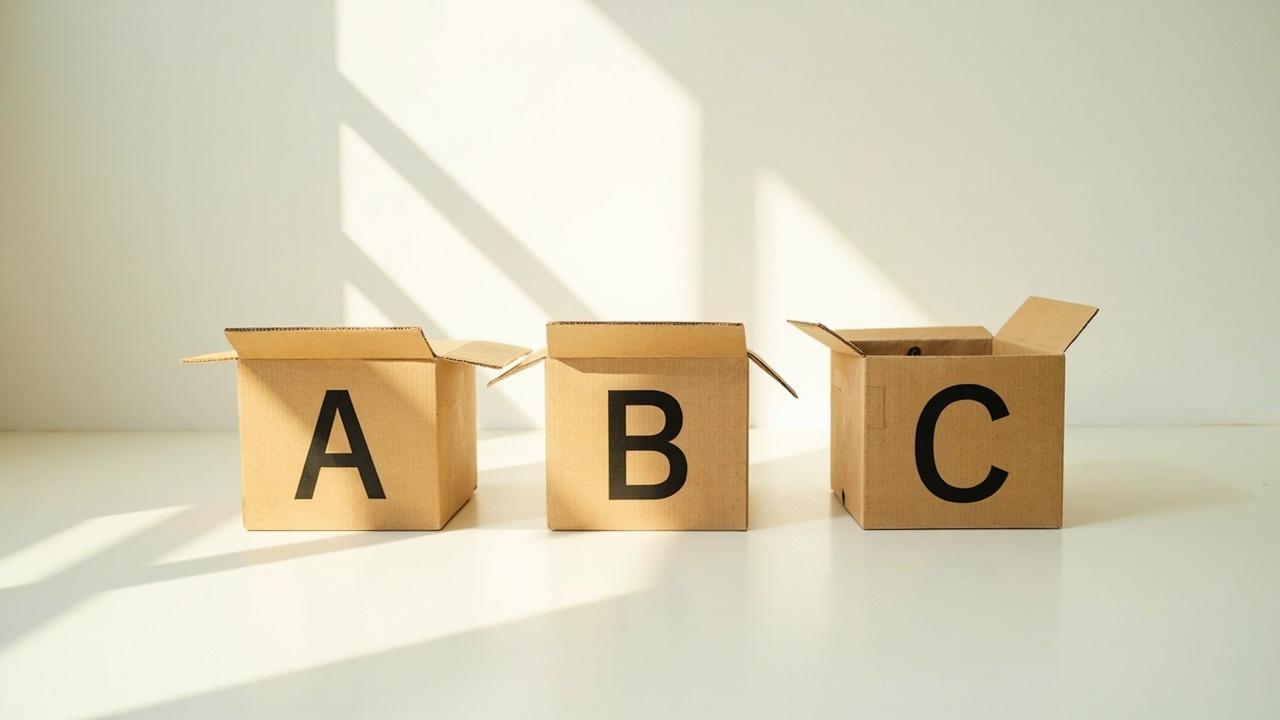
Most decluttering methods have the same failure mode: decision paralysis. KonMari asks “does this spark joy?” — but joy is vague. The 4-box method asks “Keep, Donate, Sell, or Trash?” — but most items need more context. Zone methods ask “by room” — but rooms aren’t the problem, decisions are.
The A-B-C method solves this by replacing emotion with TIME.
- A = Action Now (handle in 5 minutes or less, get it out the door)
- B = Action Soon (handle within 1 week, schedule it)
- C = Action Later (revisit in 30+ days, decide later)
Time-based decision rules clear the bottleneck that stops most people: sitting on an item for 10+ minutes deciding. The A-B-C method forces a fast decision in 5 seconds based on priority, not emotion or destination.
Why KonMari Doesn’t Work For Everyone
The KonMari method has a ~10-15% completion rate among people who start it. Why?
- “Spark joy” is subjective. What’s joy to one person is guilt to another. People get stuck deciding.
- Categories are abstract. “Books first” is rule that requires remembering an entire taxonomy.
- It expects deep engagement. 5 hours per category for “thank and release” feels right for some, but most people can’t sustain it.
- Sentimental items get charged later. When “now” arrives, you’re exhausted.
The A-B-C method solves all four problems by removing the question itself. Instead of asking “do I love this?”, you ask “do I have 5 minutes to deal with it?” — a binary answer every time.
The A-B-C Method Explained
A = Action Now (5 Min or Less)
Items you can deal with in 5 minutes or less:
- Trash (broken, expired, useless)
- Easy donations (clothes that no longer fit, books you’ve read)
- Items going to specific recipients (give to spouse, kid, friend)
The rule: if you can finish the action in 5 minutes (decide + place + write note), it’s an A. Move immediately.
B = Action Soon (Within 1 Week)
Items you can’t finish in 5 minutes but can finish in 1 week:
- Sellable items (need photo + listing + meetup)
- Larger donations (need drop-off trip or pickup)
- Repairs (need fix-it session)
The rule: schedule a specific day/time within 7 days. Add to calendar. Don’t leave B floating.
C = Action Later (30+ Days, Re-evaluate)
Items with high decision cost:
- Sentimental items (family heirlooms, gifts, photos)
- High-value items (need research, appraisal, expert opinion)
- Things you’re “not ready” to decide on
The rule: C is NOT a permanent home. Schedule a 30-day revisit. If still in C after 90 days total, force a decision.
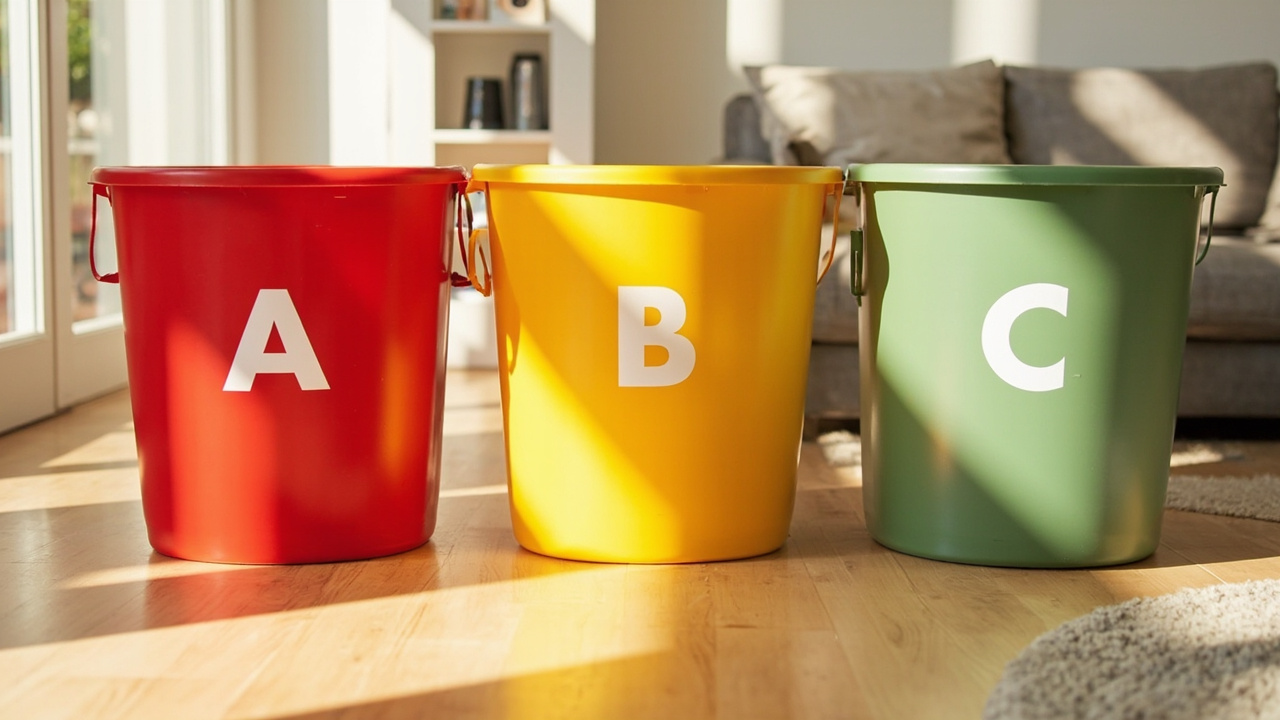
For color-coded bin labels ($11.99 for 180), use green for A, yellow for B, red for C — visual system for the whole household.
Why Time-Based Beats Emotion-Based
The research on decision fatigue is clear: we make worse decisions the longer we sit with options. KonMari takes 20-60 minutes per item because the decision rule is “feel joy.” A-B-C takes 5-30 seconds per item because the decision rule is “5 minutes or not.”
Math: 50 items × 30 seconds each = 25 minutes. Same 50 items × 20 minutes each = 16+ hours.
The A-B-C method is what professional organizers actually use. They don’t sit on each item for 20 minutes feeling joy — they sort quickly, batch by action type, and execute. The framework just makes that explicit.
For a 5-min countdown timer ($5.93 for 2), the buzzer enforces the rule. Once it rings, your decision is forced.
A-B-C Decision Tree (Visual Framework)
[Item pulled from zone]
  ↓
Can I deal with it in 5 minutes? (decide + execute)
  YES → PILE A
  NO ↓
Can I deal with it in 1 week? (schedule + execute)
  YES → PILE B
  NO ↓
PILE C (revisit in 30+ days)
Tier 1: Trash Detection
Before the A-B-C decision tree, sort trash separately. Anything broken, expired, or unsalvageable goes immediately in trash (not in any pile). This pre-pass prevents 30-50% of items from entering the decision tree.
After trash pre-pass: apply A-B-C to remaining items.
Tier 2: Action Type Detection
For items NOT in trash, ask the 5-second question:
- “Easy donate?” → A (1 minute)
- “Specific recipient (kid, friend, spouse)?” → A (1 minute to put in their box)
- “Trash but I keep putting off?” → A (force it now)
- “Sell online worth $20+?” → B (needs listing photos)
- “Donate but bulk drop-off needed?” → B (needs trip)
- “Need to research/expert?” → C
- “Sentimental?” → C (revisit later)
For a 60-min session timer ($8.99), use it to enforce the 2-hour implementation session cap.
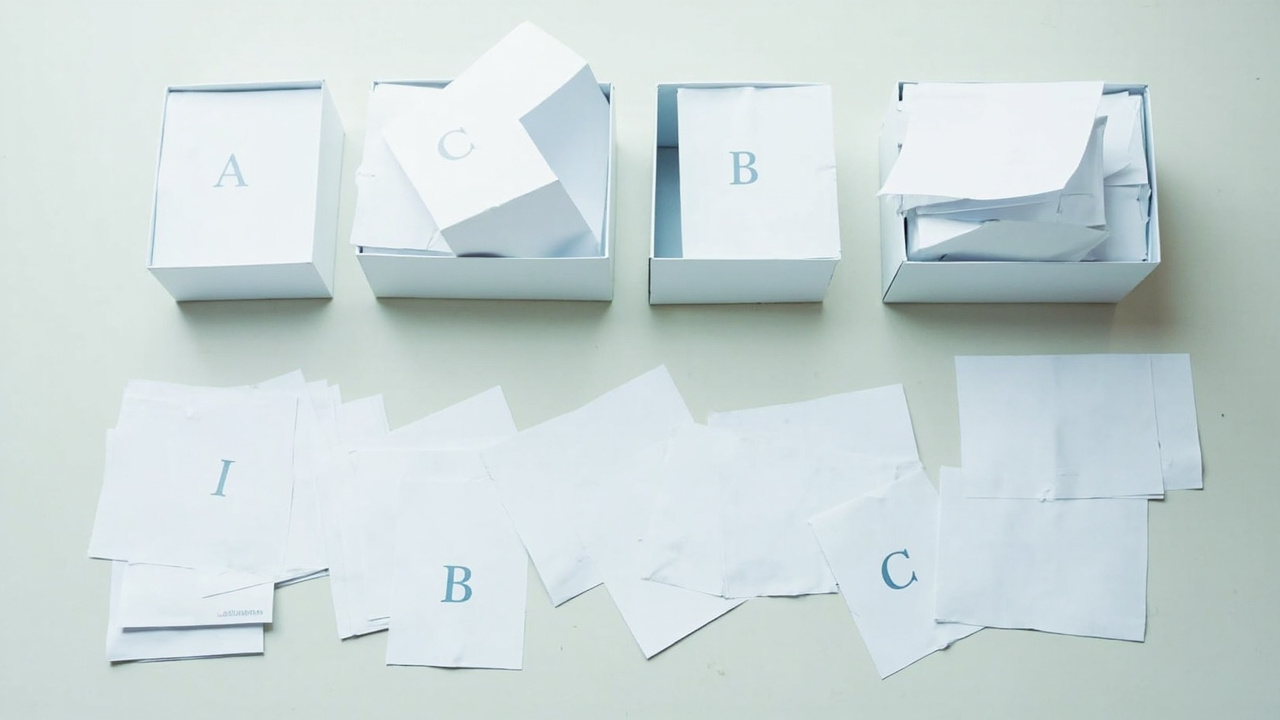
Step-by-Step 2-Hour Implementation
For each session (one zone, one room at a time):
Hour 1: Sort
- Empty one zone onto the floor (0-10 min)
- Trash pre-pass (5-15 min)
- Sort into A / B / C boxes (30-50 min)
Hour 2: Execute
-
Process A-pile (max 60 min remaining)
- 5 min per item via timer
- One type at a time (donations, recipient items, trash)
- Use a to-do notepad ($6.99) to log A-pile actions
-
Schedule B-pile (10 min)
- Specific day, specific time, specific recipients
- Add to calendar immediately (not “later”)
-
Park C-pile (5 min)
- Pre-write 30-day revisit on calendar
- Don’t reopen pile until revisit day
Total session: 2 hours max. Don’t extend. Stop when buzzer rings.
Momentum Building Tactics
Three reasons people stall after 2-3 sessions:
- Decision fatigue — brain runs out of “no” energy
- Diminishing returns — biggest wins come early
- Boredom — fewer easy decisions remain
Tactics:
- Track streaks visibly. Use a fridge chart ($12.99) to show “Session 3 ✓ Session 4 ✓ Session 5 ✓”. Visual streaks work.
- Process A-pile daily, 5-min each morning. After session, every day pick 1-2 A-pile items to handle. 30 days = 30-60 items cleaned out.

- Celebrate each session. Schedule a treat after the 2-hour session — coffee, walk, social media break. Reward reinforces habit.
For long-term tracking ($8.99 for 2), use a single notepad across all sessions for the year.
Color-Coded Visual System
Use color-coded labels to make the A-B-C system visible across your home:
When to Move Items Between Piles
The A-B-C system is bi-directional. Items move between piles as priorities change:
- A → Done: A-pile handled = item exits system entirely
- B → A: When the scheduled day arrives, B items become A (just handle them)
- C → A: When 30-day revisit arrives, C items are moved to A (decide now)
- C → B: If 30-day revisit decides “I need more time” but not 90 days, move to B
- A → C: Anytime. If you start an A item and realize you need more time (it was sentimental unexpectedly), move it to C
Use reusable chalkboard labels ($8.49 for 180) on bins to switch labels as items move.
Common Mistakes
5 mistakes to avoid:
-
Treating A-B-C like 3-box method. A-B-C is about TIME, not destination. Keep vs. Donate is a separate question. A-B-C just tells you WHEN to decide.
-
Letting items pile up in C forever. C is parking, not storage. If still in C after 90 days total, force a decision. Don’t let C be a permanent home.
-
Mixing A-pile items with B-pile items. Keep piles physically separate. Different action types. Mixing dilutes the system.
-
Skipping the 5-min per item rule. Analysis paralysis returns. The timer is enforcement. If you don’t use a timer, you fall back to 20-minute decisions.
-
Trying to do too much in one session. 2 hours max per session. Sessions longer than 2 hours show declining returns and higher likelihood of quitting.
For the implementation planner ($8.98), use a large notepad to lay out the full 2-hour plan before starting.
Constraint Guide: If-Then Decisions
4 if-then rules for A-B-C scenarios:
- IF you have 30+ items in one zone → split into 3 sessions (1 zone per session)
- IF you have time pressure (move, deadline) → bias toward A pile (handle more immediately)
- IF items are sentimental → start in B pile (more time to decide)
- IF you live with others → use color-coded labels so each person tracks
FAQ
What is the ABC method of decluttering?
A-B-C is a TIME-BASED triage system: A = Action Now (5 min or less), B = Action Soon (1 week), C = Action Later (revisit in 30+ days). Unlike KonMari’s emotion-based or 4-box’s destination-based, A-B-C uses time as the decision rule. Faster decisions, less analysis paralysis.
Is ABC method better than KonMari?
For people who don’t resonate with “spark joy” — yes. KonMari has a 10-15% completion rate; A-B-C prioritizes momentum over emotion. A-B-C is faster (5 sec per item vs. 20+ min). However, KonMari teaches deeper philosophy of intentional living; A-B-C is purely tactical.
How long does the A-B-C method take?
Each session = 2 hours max. Plan 1-2 sessions per week. Most homes take 8-12 sessions (4-6 weeks) to fully purge with A-B-C. The “C pile revisit” happens 30 days after first sorting; full system matures at 90 days.
What goes in the C pile?
Three things: (1) Sentimental items (family heirlooms, gifts), (2) High-value items needing research/expert, (3) Items you’re “not ready” to decide on. C is parking for a forced revisit, NOT permanent storage.
Related Methods & Frameworks
For other decluttering methods:
- KonMari Method — emotion-based, philosophy-heavy
- Declutter Fast — 4-quadrant tactical method
- FlyLady Method — daily-routine based (T5 declutter-guide)
- Zone Cleaning Method — zone-by-zone rotation
For practical implementation:
- Declutter on a Budget — DIY tools during A-B-C sessions
- Declutter Before Moving — A-B-C adapted for moves
- Declutter Maintenance Routine — prevent re-cluttering after A-B-C
For the full Learn library: /learn/ — 11 articles spanning theory + practice.
For the full decluttering philosophy series, see Theory Track — 2 method guides (KonMari + A-B-C) + future additions (FlyLady, Zone Cleaning, 5S, Swedish Death Cleaning).

After the Session: Reflection