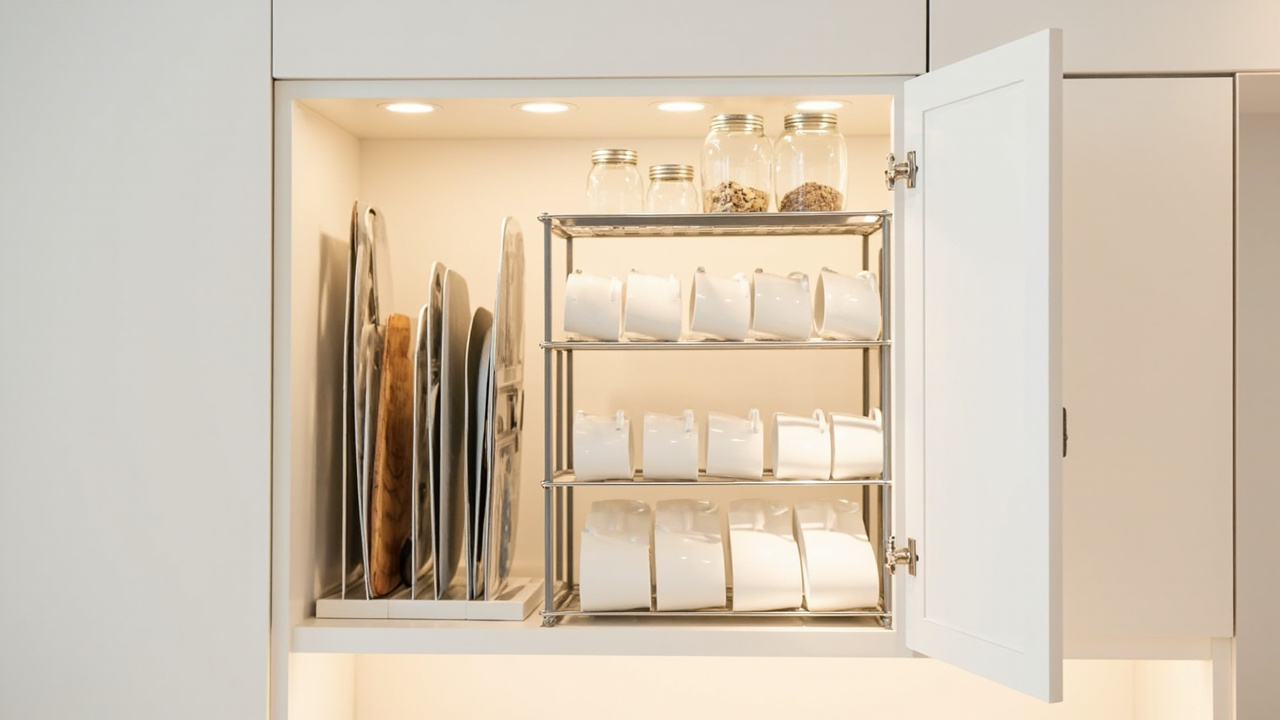
Kitchen cabinets fail for 3 structural reasons: no zone system (items go anywhere they fit, so dishes end up next to cleaning supplies), duplicate items (two whisks, three sets of measuring cups), and rarely-used items in front (wedding-gift appliances hide the daily blender). Compounding these: deep lower cabinets are the worst — 60% of usable space is items forgotten at the back.
This guide covers the 4-zone cabinet system + the 8-category map + Layout by Cabinet Type + constraint guide + 5 common mistakes + 3-tier maintenance rhythm. Sister cross-links: kitchen pantry organization, spice organization, and small kitchen organization.
Why Kitchen Cabinets Get Messy
Three forces — no zone system, duplicate items, rarely-used items in front — combine to overwhelm any cabinet.
The fix is the 4-zone cabinet system + 8-category map: assign each cabinet a purpose, each category to a zone, then match the right product to each zone. Competitors skip the category breakdown and end up with dishes next to cleaning supplies.
What You’ll Need
Four products cover all 4 zones — total cost ~$107.
Lazy Susan (Zone 2 Lower Cabinets — corner reach)
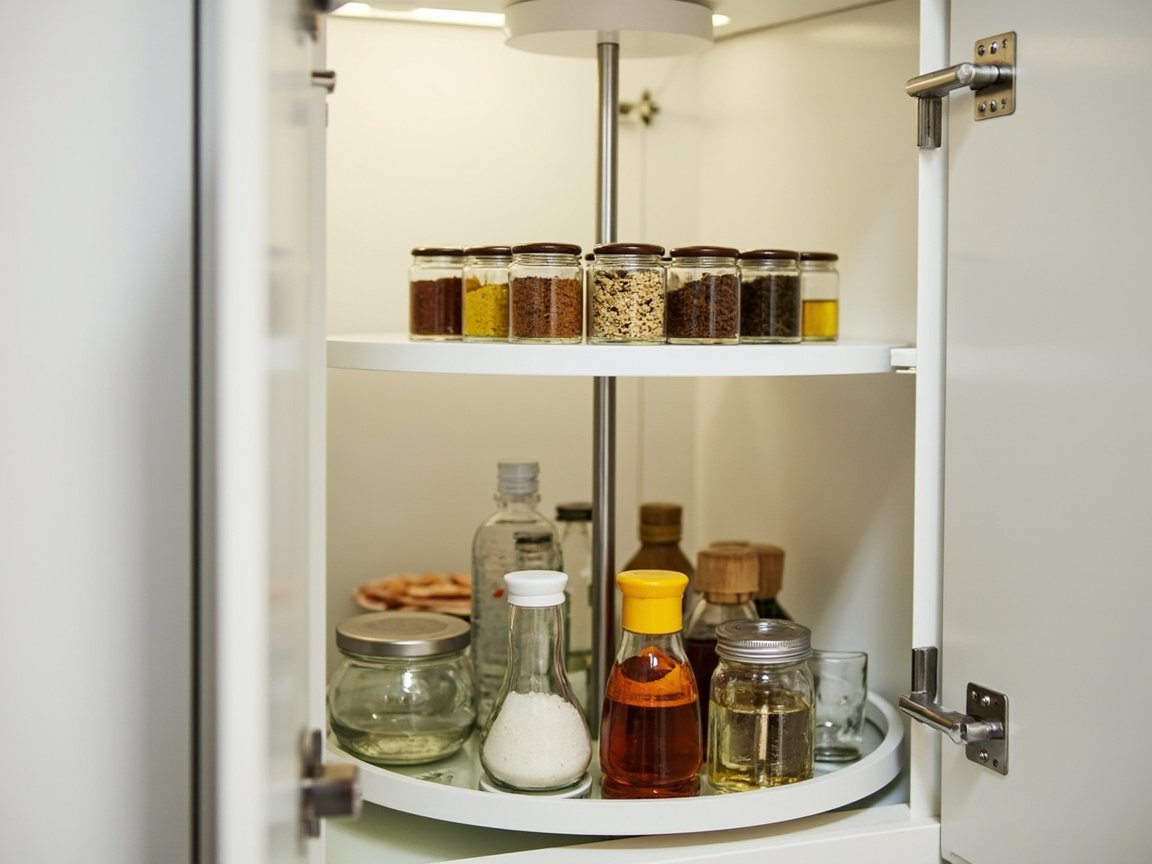
The Copco 18-Inch Lazy Susan Turntable — 18” diameter fits standard upper-corner cabinets. Spin to reach back items. $17.57.
Pull-Out Drawers (Zone 2 Lower Cabinets — deep reach)
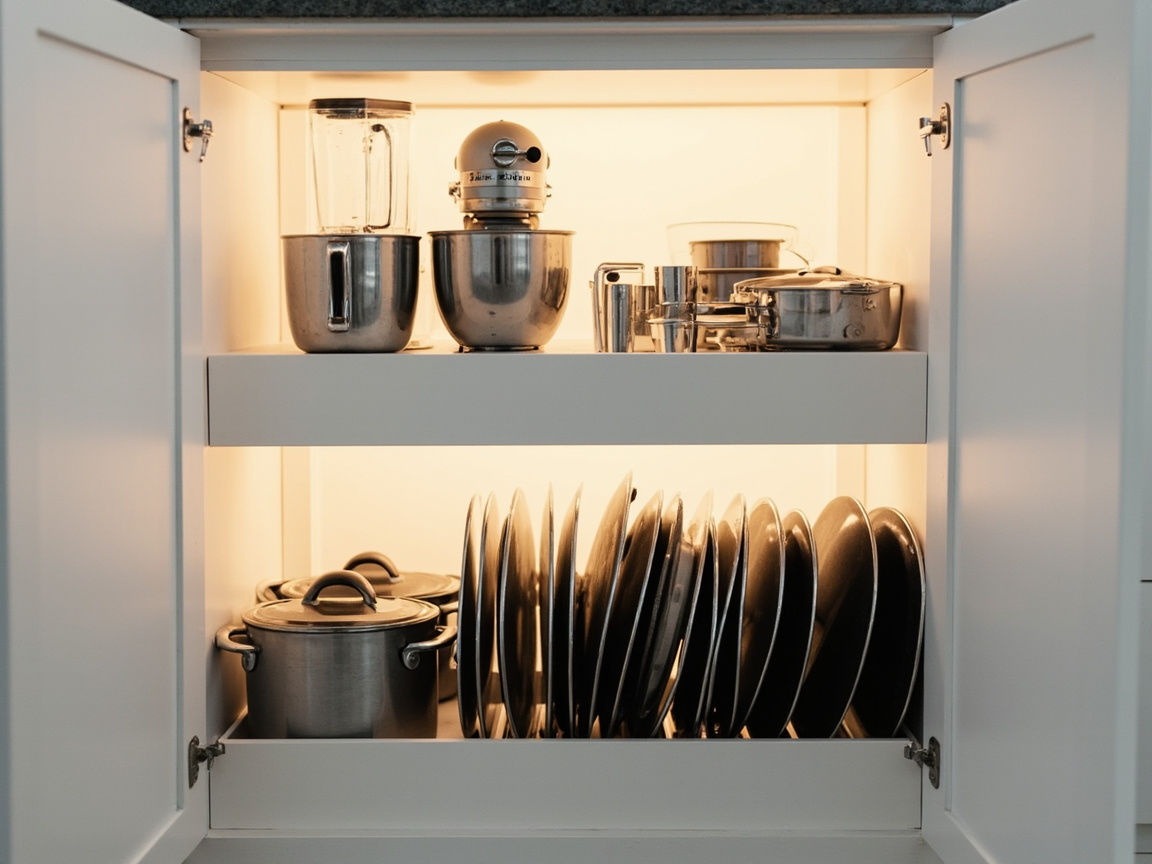
The Delamu Pull-Out 2-Tier Cabinet Organizer brings back items in deep lower cabinets (12”+ deep). Heavy-duty 50 lb. $69.99.
Under-Shelf Basket (Zone 1 Upper Cabinets — vertical add-on)
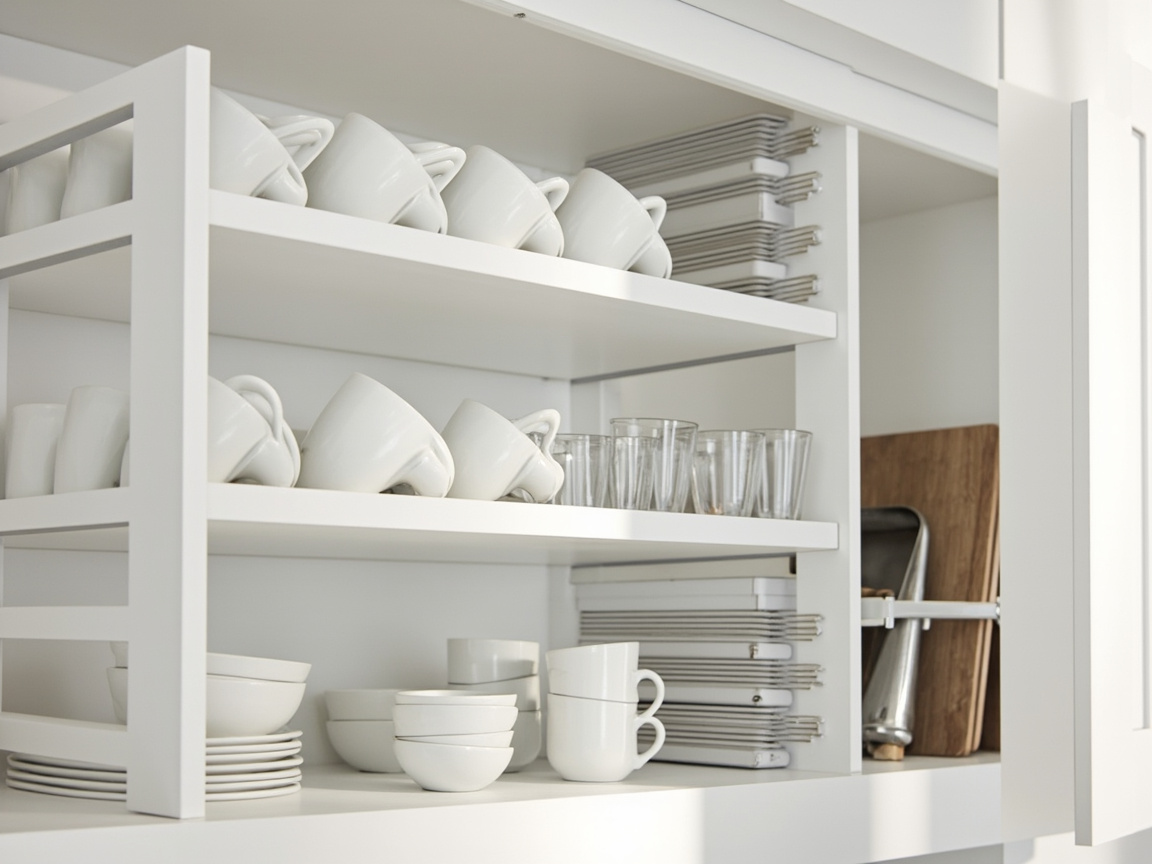
The AmonHouseware Under-Shelf Basket 2-Pack adds a hidden basket layer for wraps, foil, mugs. Slide-in, no drilling. $33.99 for 2-pack.
3-Tier Shelf Riser (Zone 1 Upper Cabinets — visibility upgrade)
The Copco 3-Tier Cabinet Shelf Riser is the cheapest entry — $6.78 turns 1 cabinet shelf into 3 visible levels.
The 5-Step Method
Order matters. Declutter first, then categorize, then map to zones.
Step 1: Empty + clean + categorize
Pull EVERYTHING out of ONE cabinet at a time. Wipe shelves. Sort into 3 piles: keep / relocate / trash. Apply the declutter-fast 4-quadrant method kitchen-wide. Common trash: duplicate utensils, gadgets used once, empty spice jars, broken mugs, untouched appliances. Move food to kitchen pantry organization.
Step 2: Apply the 8-category system
Sort the keep-pile into 8 categories: Pots & Pans / Bakeware / Dishes / Glassware / Utensils / Small Appliances / Pantry/Food / Cleaning. Use KonMari-style grouping by category not location. Spices get their own sub-system — see spice organization guide.
Step 3: Map categories to cabinet zones
Match each category to one of the 4 zones based on weight + frequency: Zone 1 (Upper) — daily dishes, glasses, mugs, packaged food (light, daily). Zone 2 (Lower) — pots, pans, small appliances, baking sheets. Zone 3 (Pantry) — dry goods. Zone 4 (Drawer) — utensils.s (heavy, weekly). Zone 3 (Pantry-Style Cabinet / Tall) — dry goods, bottles, cans, spice jars (medium, weekly). Zone 4 (Drawer Cabinets) — utensils, gadgets, tools, sharp items (small, daily).
Step 4: Choose the right organizer
For each zone, select the matching product: corners + back-of-lower-cabinet → lazy susan (turntable). Deep lower cabinets (12”+ deep) → pull-out drawers (slide-out). Upper cabinet vertical space → under-shelf basket (slide-in). Flat-shelf visibility → 3-tier riser (stacked tiers).
Step 5: Stage by frequency + maintain
Apply the front-daily / back-occasional rule. Within each zone, place daily-use items at the front (eye level for upper; knee level for lower). Less-frequent items at the back. Quarterly follow seasonal-closet-rotation.
Layout by Cabinet Type
The differentiator: cabinet-type-specific layouts.
Upper cabinets (above counter)
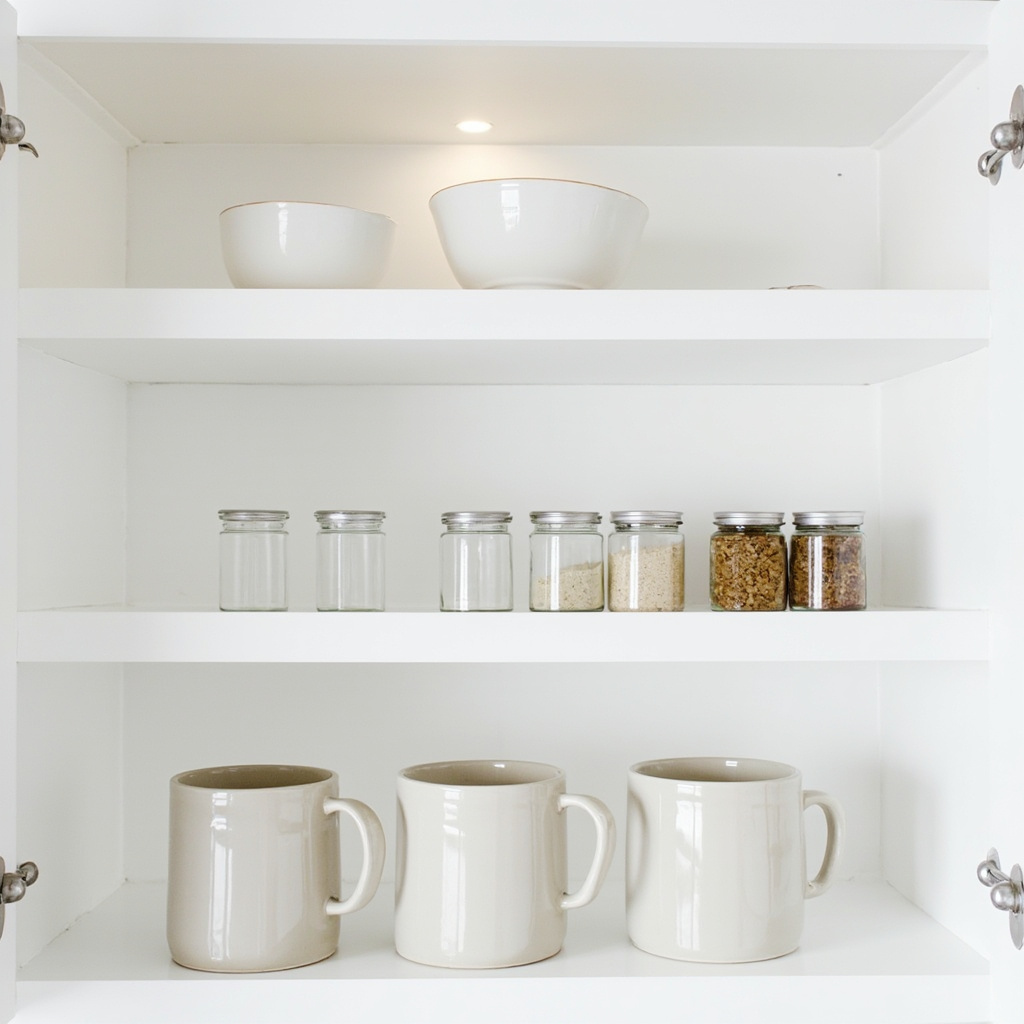
Apply the 8-category rule to dishes + glassware + mugs. Use the 3-tier shelf riser for glasses visibility. Add the under-shelf basket for wraps, foil, cutting boards. Front-daily: cereal bowls + everyday glasses. Back: holiday china + serving platters.
Lower cabinets (below counter)
Deep lower cabinets are the #1 pain point — 60% of stored items are forgotten at the back. Two solutions: (1) Lazy susan for corner cabinets; (2) Pull-out drawers for straight-run lower cabinets.
Pantry-style cabinet (tall narrow)
Apply kitchen pantry organization logic: top = rarely-used, middle = daily, bottom = heavy. For spices, follow spice organization guide.
Drawer cabinets (utensils, gadgets, tools)
Apply vanity-drawer organization logic for utensils: cooking tools / prep tools / serving tools / measuring / sharp / gadgets.
Constraint Guide by Scenario
Four scenarios cover most kitchen-cabinet constraints.
Rental / can’t drill
Drilling in cabinets damages interiors + reduces deposit. Use under-shelf baskets (slide-in), lazy susans (drop-in), 3-tier risers (sit on shelf). Skip pull-out drawers — they require mounting hardware.
No pantry
Apartment with NO separate pantry? Use one pantry-style cabinet as dry-goods storage. Apply kitchen pantry organization 3-tier rule: top = backup/rarely-used, middle = daily, bottom = heavy. Add 3-tier risers.
Deep cabinets
Cabinets deeper than 12” lose 60% of usable space. Solutions: (1) Pull-out drawers — slide everything forward; (2) Lazy susan — spin to reach back; (3) Repurpose under-shelf basket as a flat-bin at the front.
Tight budget under $50
Apply single-product approach: pick the 3-tier shelf riser ($6.78) for ALL cabinets. Add the lazy susan ($17.57) for one corner. Total $24.35.
Common Mistakes
Five failure patterns in nearly every kitchen cabinet that stays messy:
-
Buying organizers before decluttering. Most people buy bins/baskets before emptying cabinets. Fix: apply declutter-fast 4-quadrant first, then measure the keep-pile, then buy organizers.
-
Storing heavy items on upper shelves. Appliances on upper cabinets cause back strain. Fix: move all items >5 lb to lower cabinets.
-
Treating all cabinets as identical. Using one size-fits-all product everywhere. Fix: match each zone to its product — corners → lazy susan, deep lower → pull-out, flat upper → tiered risers.
-
Not measuring cabinet depth before buying. Buying a 21”-deep pull-out for an 18”-deep cabinet. Fix: measure cabinet interior before buying. Standard base cabinet is 24” deep × 12” wide.
-
Ignoring the kitchen pantry vs cabinet distinction. Cramming food in upper cabinets designed for dishes. Fix: apply kitchen pantry organization for food zones. Use KonMari “category not location”.
Maintenance: Quarterly Reset + Annual Declutter
Apply the 3-tier maintenance rhythm.
Daily (30 sec): Wipe counters, return dishes.
Monthly (10 min): Restock staples; check expired food.
Quarterly (45 min): Pull everything, deep-clean, swap seasonal items. Apply seasonal-closet-rotation principle.
Annually (3 hours): Full cabinet-wide declutter using KonMari “sparks joy”.
For kitchen context, see the kitchen hub and our kitchen pantry organization, spice organization, small kitchen organization, and pantry checklist for pantry-specific deep-dive. The general method is declutter-fast; the joy-check is KonMari method; the quarterly rhythm is seasonal-closet-rotation. For product deep-dives, see storage bins and shelf organizers.